Is tax-loss harvesting legal?
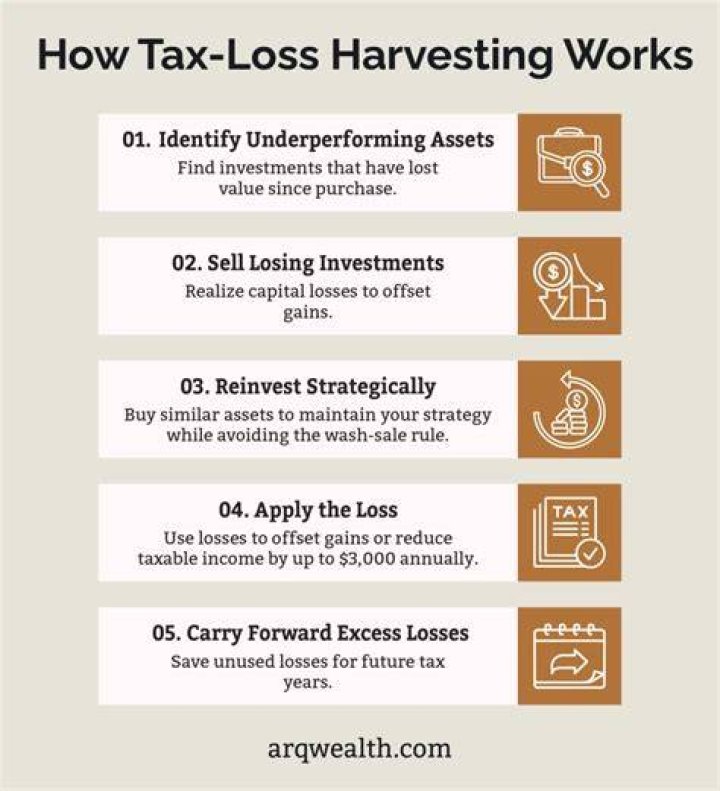
You can harvest losses to offset gains as well as up to $3,000 in non-investment income. According to the wash-sale rule, when you harvest losses, you cannot repurchase substantially identical investments for 30 days. Tax-loss harvesting only applies to taxable investment accounts, not retirement accounts.
What is tax loss harvesting example?
Understanding Tax-Loss Harvesting For example, suppose an individual invests $10,000 in an exchange traded fund (ETF) at the beginning of the year. Then this ETF decreases in value by 10% and drops to a market value of $9,000. This is considered a capital loss of $1,000.
Can you tax loss harvest short term losses?
You can tax harvest both short-term and long-term losses. Short-term losses are on an investment held less than a year. Long-term losses are for investments held longer than a year. Long-term capital gains are typically taxed at a much lower rate than short-term gains.
How much money does tax loss harvesting save?
It does appear that tax-loss harvesting is a useful strategy to improve after-tax performance if history is any guide, perhaps by around 1% a year. However, your actual results will depend on a host of factors from market conditions to your tax rates and trading costs.
What is tax gain harvesting?
Tax gain harvesting, as opposed to tax-loss harvesting, is the process of turning unrealized long-term capital gains into realized capital gains at a specific time for tax purposes.
When do you use tax loss harvesting strategy?
Usually, this strategy is implemented near the end of the calendar year but may happen at any time in a tax year. With tax-loss harvesting, an investment that has an unrealized loss is sold allowing a credit against any realized gains that occurred in the portfolio.
What do you need to know about capital loss harvesting?
High-income taxpayers with short-term gains to offset can earn back almost two-fifths of their investment losses by taking the capital loss tax break. In order to harvest tax losses, all you have to do is sell the stock. However, you can’t simply buy back the stock immediately thereafter.
Who is Janet Berry Johnson and what is tax loss harvesting?
Janet Berry-Johnson is a CPA with 10 years of experience in public accounting and writes about income taxes and small business accounting. What Is Tax-Loss Harvesting? Tax-loss harvesting is the selling of securities at a loss to offset a capital gains tax liability.
How are gains and losses reported on taxes?
First long-term gains and losses are netted against each other, as are short-term gains and losses. After this, the net long-term gain or loss is netted against any short-term gains and losses with the net number is then reported as a net gain or loss for the client’s taxes for the year.
