What is the amount of passive activity losses allowed in 2019?
$25,000
The passive loss allowance which allows taxpayers with a Modified Adjusted Gross Income (MAGI) of less than $100,000 to deduct up to $25,000 of passive losses against their other income. This $25,000 deduction is phased out $1 for every $2 that MAGI increases above $100,000.
Can I offset capital gains with passive losses?
And contrary to the popular misconception, capital gains and dividend income are not considered to be passive activity income, so you can’t use passive activity losses to offset these types of income either.
What are the rules for passive activity losses?
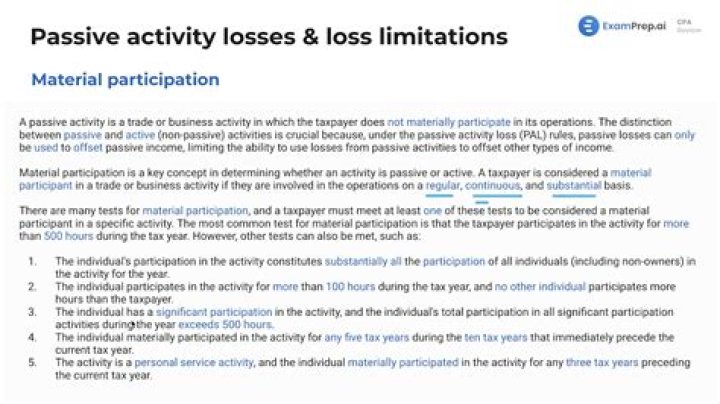
Passive activity loss rules are a set of IRS rules stating that passive losses can be used only to offset passive income. A passive activity is one wherein the taxpayer did not materially participate in its ongoing operation during the year in question. Common passive activity losses may stem from leasing equipment, real estate rentals.
How much passive loss can I claim on taxes?
Passive Activity Limits Under the passive activity rules you can deduct up to $25,000 in passive losses against your ordinary income (W-2 wages) if your modified adjusted gross income (MAGI) is $100,000 or less. This deduction phases out $1 for every $2 of MAGI above $100,000 until $150,000 when it is completely phased out.
What are the disallowed passive activity tax deductions?
Identification of Disallowed Passive Activity Deductions A B C Total Gross income $7,000 $4,000 $12,000 $23,000 Deductions (16,000) (20,000) (8,000) (44,000) Net income (loss) ($9,000) ($16,000) $4,000 ($21,000)
Is the TCJA going to change passive loss rules?
The Tax Cuts and Jobs Act (TCJA), the massive tax law enacted by Congress that took effect in 2018, did not alter the passive loss rules. They remain in place.
